
There was a story today in the news about how over a hundred celebrities had their Apple iCloud accounts hacked. The hackers proceeded to post nude photos of these stars, found in the cloud, online. Experts determined that the hackers simply logged in by claiming that they had lost their passwords and answering the celebrities' security questions. Amazing.
No - this isn't Bill Hamilton. I'm his son Derek Hamilton.
My father influenced my thinking on so many things. When I went off to college, I remember calling home and occasionally getting him on the phone in a talkative mood. We had long conversations on everything from current events, math, politics -- and his favorite topic -- theories of the origins of the universe. Every topic was considered - the more arcane the better.
Not long after he died in January of 2012 I went back to his blog bricolagia and read through his entries. I'm embarrassed to admit, I didn't read his blogs consistently when he was alive. But after he had passed, it was comforting to read his words again. I can still hear his voice in his writings.
For a long time after that, I though that it would be fun to try to find login credentials for his BlogSpot account (now Blogger) - and continue the writing. But I wasn't sure of how to go about this task. Alas, I was inspired by today's news and decided to try. Luckily for me, the task was easy. Dad almost always used the same password - or a variant of it.
By no means do I consider myself in the same vane that I regard my father. He was deeply intelligent. But as I see things in the news that I know he would comment on - I'm going to continue to add to his blog.
In the age of the militant Islamic terrorist group ISIS, Russian aggression into Ukraine, beheadings of American journalists and nude celebrity photo bombs - I know that dad would have something to say.
Tuesday, September 2, 2014

Saturday, June 26, 2010
Thoughts on Conservative strategy for the 2010 Midterm Elections and beyond
To date the news from the primaries has been mostly good. Conservatives are winning big. That's good, but if we are going to turn this country around we need to be thinking about our message for November. Obviously we want to halt the slide toward socialism, but independents, who may be crucial in this election, will want to know where we are planning to go. For example, we have said we want to repeal and replace Obama Care. Independents legitimately ask, "Replace it with what?" To avoid sounding negative, Conservatives should simply say they want to replace Obama Care with an approach to health care that gives the patient choice and control and won't break his bank account. Some good examples of health care initiatives can be found at the Center for Health Transformation (http://www.healthtransformation.net/cs/health_solutions_lab)
Illegal immigration is another hot button issue that needs to be handled carefully. The first issue that needs to be addressed is border enforcement. Illegals who commit crimes (in addition to violating our borders) need to be criminally prosecuted. But what of the 12 million or so illegal immigrants who work, pay taxes and don't cause trouble? Why not offer those who can document that they have been in the US for say 10 years a path to citizenship? And once the borders are secured a guest worker program should be started to enable those who want to work in agriculture, construction or any other field where they are needed to come to the US for a definite period of time. Since they would be required to register with ICE the opportunity for unscrupulous employers to cheat them on salary and benefits would be limited, and terrorists trying to cross th border could be caught.
One thing Conservatives should unequivocally oppose is further deficit spending. No more "stimulus" bills. Conservatives should also advocate making the Bush tax cuts permanent.
Thinking beyond the November election, Conservatives need to develop a strategy to avoid mischief by the lame duck Congress between the election recess and January. Filibusters can be mounted in the Senate. In the House no provision for a filibuster exists. However, Congressmen can begin introducing bills that will be part of their legislative agenda for 2011. Each bill will occupy some House time and thereby delay the Democrat majority bills. Discharge petitions can be used to unlock bills tied up in committee.
Illegal immigration is another hot button issue that needs to be handled carefully. The first issue that needs to be addressed is border enforcement. Illegals who commit crimes (in addition to violating our borders) need to be criminally prosecuted. But what of the 12 million or so illegal immigrants who work, pay taxes and don't cause trouble? Why not offer those who can document that they have been in the US for say 10 years a path to citizenship? And once the borders are secured a guest worker program should be started to enable those who want to work in agriculture, construction or any other field where they are needed to come to the US for a definite period of time. Since they would be required to register with ICE the opportunity for unscrupulous employers to cheat them on salary and benefits would be limited, and terrorists trying to cross th border could be caught.
One thing Conservatives should unequivocally oppose is further deficit spending. No more "stimulus" bills. Conservatives should also advocate making the Bush tax cuts permanent.
Thinking beyond the November election, Conservatives need to develop a strategy to avoid mischief by the lame duck Congress between the election recess and January. Filibusters can be mounted in the Senate. In the House no provision for a filibuster exists. However, Congressmen can begin introducing bills that will be part of their legislative agenda for 2011. Each bill will occupy some House time and thereby delay the Democrat majority bills. Discharge petitions can be used to unlock bills tied up in committee.
Tuesday, June 15, 2010
Keynesian Economics has not been practiced
Frequently you hear that the government is practicing Keynesian economics because it is running a deficit budget.
Named for John Maynard Keynes, a British economist of the mid 20th century, Keynesian economics was popular in the Depression era, when it indeed led to budget deficits.
But that was not the whole of Keynesian economics. Keynes was preoccupied with stabilizing the economy -- keeping the value of money from going up or down excessively. His approach to doing this was to make government spending counter cyclical. When the economy was good the government should run a surplus, and when it was bad the government should run a deficit. In this way, at least in theory, the government would build up a "rainy day" fund during good times to tide it over during bad times.
Unfortunately, our leaders in Washington have almost never practiced Keynesian economics. They have run deficit budgets year in and year out, leading to today's 13 Trillion accumulated debt (and if the off-budget debt due to Social Security, Medicare and other entitlements is included it's much larger)
Should the government practice true Keynesian economics? Well, it would be better than the current situation, but the potential for abuse is great. Economic projections are notoriously inaccurate, giving politicians excuses to pour out benefits in the hope that it will lead to more votes for their reelection. Better to have expenditures in line with the budget Congress adopts.
Named for John Maynard Keynes, a British economist of the mid 20th century, Keynesian economics was popular in the Depression era, when it indeed led to budget deficits.
But that was not the whole of Keynesian economics. Keynes was preoccupied with stabilizing the economy -- keeping the value of money from going up or down excessively. His approach to doing this was to make government spending counter cyclical. When the economy was good the government should run a surplus, and when it was bad the government should run a deficit. In this way, at least in theory, the government would build up a "rainy day" fund during good times to tide it over during bad times.
Unfortunately, our leaders in Washington have almost never practiced Keynesian economics. They have run deficit budgets year in and year out, leading to today's 13 Trillion accumulated debt (and if the off-budget debt due to Social Security, Medicare and other entitlements is included it's much larger)
Should the government practice true Keynesian economics? Well, it would be better than the current situation, but the potential for abuse is great. Economic projections are notoriously inaccurate, giving politicians excuses to pour out benefits in the hope that it will lead to more votes for their reelection. Better to have expenditures in line with the budget Congress adopts.
Saturday, June 12, 2010
Are the oceans cooling?
A recent discussion among myself and two friends brought up the contention made by a couple of Climatological web sites that the oceans have been cooling recently. The web sites in question are:
here and here.
Another source of ocean temperature data is here.
Plotting the data from the third source (the NOAA data for 180W - 100W, which covers most of the tropical Pacific Ocean) doesn't give much insight into cooling. A linear regression gives a very slight cooling, but that's probably just an artifact of where the regression starts and ends:

One fact that jumps right out is that the ocean temperature fluctuates quite a bit, and this can translate into greater atmospheric temperature fluctuations near the surface because of the higher specific heat of water.
The decline in ocean temperature my friend and the two web sites were referring to is the decline from late 2009 to the present (latest data May 2010):
 This represents nearly a 3 degree (C) decline, but it's not all that much compared to earlier fluctuations (see the first figure). A Google Scholar search turned up a number of papers on ocean temperature, mostly showing warming, but all with considerable up and down fluctuations.
Still, it's of interest to assess the causes of ocean temperature fluctuations. It doesn't seem the oceans should be affected as much by the greenhouse effect as the atmosphere, since greenhouse gases trap rising heat. It would seem the ocean temperature would be more directly affected by the Total Solar Irradiance (TSI) and by cloud cover, which in turn is driven (among other things) by cosmic rays. Sunspots affect the TSI, and sunspots are currently in decline, as shown in the following figure:
 When sunspots are low, less energy is released by the sun, contributing to less warming due to TSI. Furthermore, the magnetic field of the sun is at its lowest, letting more cosmic rays impinge on the atmosphere. This in turn causes more air to be ionized, which provides nuclei for clouds to condense around, increasing cloud cover and increasing the reflectance of solar radiation back into space. This of course cools the atmosphere. Also, some recent research by Qing-Bin Lu of the University of Waterloo, links the decline of CFC gases (chlorofluorocarbons once used as refrigerants and according to Professor Lu, "well known greenhouse gases") under the influence of cosmic rays to the recent cooling of the atmosphere.
My conclusions:
here and here.
Another source of ocean temperature data is here.
Plotting the data from the third source (the NOAA data for 180W - 100W, which covers most of the tropical Pacific Ocean) doesn't give much insight into cooling. A linear regression gives a very slight cooling, but that's probably just an artifact of where the regression starts and ends:

One fact that jumps right out is that the ocean temperature fluctuates quite a bit, and this can translate into greater atmospheric temperature fluctuations near the surface because of the higher specific heat of water.
The decline in ocean temperature my friend and the two web sites were referring to is the decline from late 2009 to the present (latest data May 2010):
 This represents nearly a 3 degree (C) decline, but it's not all that much compared to earlier fluctuations (see the first figure). A Google Scholar search turned up a number of papers on ocean temperature, mostly showing warming, but all with considerable up and down fluctuations.
Still, it's of interest to assess the causes of ocean temperature fluctuations. It doesn't seem the oceans should be affected as much by the greenhouse effect as the atmosphere, since greenhouse gases trap rising heat. It would seem the ocean temperature would be more directly affected by the Total Solar Irradiance (TSI) and by cloud cover, which in turn is driven (among other things) by cosmic rays. Sunspots affect the TSI, and sunspots are currently in decline, as shown in the following figure:
 When sunspots are low, less energy is released by the sun, contributing to less warming due to TSI. Furthermore, the magnetic field of the sun is at its lowest, letting more cosmic rays impinge on the atmosphere. This in turn causes more air to be ionized, which provides nuclei for clouds to condense around, increasing cloud cover and increasing the reflectance of solar radiation back into space. This of course cools the atmosphere. Also, some recent research by Qing-Bin Lu of the University of Waterloo, links the decline of CFC gases (chlorofluorocarbons once used as refrigerants and according to Professor Lu, "well known greenhouse gases") under the influence of cosmic rays to the recent cooling of the atmosphere.
My conclusions:
- The study of earths temperature cannot be complete with the main emphasis on CO2
- Although the oceans temperature fluctuates considerably, the higher heat capacity of water argues strongly for including the influence of the oceans on earth's temperature
- Factors like sunspots and cosmic rays must be taken into account.
Cosmic-ray-driven electron-induced reactions
of halogenated molecules adsorbed on ice surfaces:
Implications for atmospheric ozone depletion
and global climate change
Physics Reports, Volume 487, Issue 5,
February 2010, Pages 141-167,
ISSN 0370-1573, DOI: 10.1016/j.physrep.2009.12.002.
(http://www.sciencedirect.com/science/article/B6TVP-4XVC4M5-
1/2/643db802d858c3d6e2ec9b78627fea24)
Galactic Cosmic Rays - Clouds Effect and Bifurcation
Model of the Earth Global Climate. Part 1. Theory
Authors: Vitaliy D. Rusov, Alexandr V. Glushkov,
Vladimir N. Vaschenko, Oksana T. Mykhalus,
Yuriy A. Bondartchuk, Vladimir P. Smolyar,
Elena P. Linnik,
Strachimir Cht. Mavrodiev, Boyko I. Vachev
The Journal of Atmospheric and Solar-Terrestrial
Physics Vol. 72 (2010) p. 398-408
arXiv:0803.2765v3 [physics.ao-ph]Galactic Cosmic Rays - Clouds Effect and Bifurcation
Model of the Earth Global Climate. Part 2.
Comparison of Theory with Experiment
Authors: Vitaliy D. Rusov, Vladimir N. Vaschenko,
Elena P. Linnika, Oksana T. Myhalus,
Yuriy A. Bondartchuk,
Vladimir P. Smolyar, Sergey I. Kosenko,
Strachimir Cht. Mavrodiev,
Boyko I. Vachev
Journal of Atmospheric and Solar-Terrestrial
Physics Vol. 72 (2010) p. 380-497
arXiv:0803.2766v3 [physics.ao-ph]Testing the proposed link between cosmic rays
and cloud cover
Authors: T. Sloan, A.W. Wolfendale
Lancs-HEP/080309
arXiv:0803.2298v1 [physics.ao-ph]
Tuesday, June 8, 2010
Update -- Myeloma
See my post from Friday May 28.
Linda and I drove to Houston June 2 to see Dr. Orlowski, our oncologist at M. D. Anderson. The results of two cycles of chemo look excellent. Not all results were in yet, but the immunoglobulin IgG went from 6200 March 15 to 2330 June 2 -- a 62% reduction. Dr. Orlowski estimates I will need 4 to 6 cycles before the stem cell transplant.
Meanwhile I started the third cycle of chemo yesterday. Today I feel good, which is a contrast from previous cycles. I have been a little anemic, from prior to being diagnosed, and the nurse practitioner suggested I eat liver, dark, leafy greens, etc. She thought that would be better than the constipation that might result from taking iron pills. Since I've had enough constipation to last me the rest of my life, we stopped at Luby's on the way home and I had liver. Maybe that was a factor.
To anyone out there who is praying for me: Thanks. I know many people are praying for me.
Linda and I drove to Houston June 2 to see Dr. Orlowski, our oncologist at M. D. Anderson. The results of two cycles of chemo look excellent. Not all results were in yet, but the immunoglobulin IgG went from 6200 March 15 to 2330 June 2 -- a 62% reduction. Dr. Orlowski estimates I will need 4 to 6 cycles before the stem cell transplant.
Meanwhile I started the third cycle of chemo yesterday. Today I feel good, which is a contrast from previous cycles. I have been a little anemic, from prior to being diagnosed, and the nurse practitioner suggested I eat liver, dark, leafy greens, etc. She thought that would be better than the constipation that might result from taking iron pills. Since I've had enough constipation to last me the rest of my life, we stopped at Luby's on the way home and I had liver. Maybe that was a factor.
To anyone out there who is praying for me: Thanks. I know many people are praying for me.
Friday, June 4, 2010
A Tale of Two Registry Cleanup Utilities
My wife has a PC, I use a Macintosh. Several years ago I got a registry cleanup program from Iolo that did a good job of straightening out registry issues. But then Iolo decided to go into the firewall, antivirus, antieverything business and bundled their registry cleanup utility with everything else. However, I was using another firewall/antivirus program and had no desire to switch, After all, I had a license valid for a year, the program worked fine, and I had three total installations, including one under Parallels on the Macintosh and one under VMWare on the PC (the license allows this). Iolo included the ability to detect third party antivirus/firewall programs, but their program failed to detect the antivirus/firewall program I was using. So I got bogus warnings, "No firewall detected. Antivirus not detected."
Meantime my wife's computer ran more and more slowly. Finally I got an email from Smith Micro announcing a registry cleaner called Checkit. I ordered it and installed it last night. I ran it and my wife is happy. The computer runs much faster now. It's a shame Iolo had to take a simple program and tie it together with other layers of code to do much more than I wanted done, but from initial experience, Checkit will do the job.
Meantime my wife's computer ran more and more slowly. Finally I got an email from Smith Micro announcing a registry cleaner called Checkit. I ordered it and installed it last night. I ran it and my wife is happy. The computer runs much faster now. It's a shame Iolo had to take a simple program and tie it together with other layers of code to do much more than I wanted done, but from initial experience, Checkit will do the job.
Saturday, May 29, 2010
Some fun questons
Following is a list of short questions I've wondered about for years.
- Why is Tucson (Arizona) pronounced Tooson? Shouldn't it be Tuckson? Don't tell me it was originally Spanish, because in Spanish it would be Tuckson (or maybe Tookson). Maybe it comes from an Indian word?
- Why is Boston cream pie pie instead of cake? Pie has a crust, cake doesn't.
- Similarly, why is cheesecake cake and not pie, since it has a crust?
- Why do they call movie previews trailers?
Friday, May 28, 2010
Where I’ve been
From sometime in February until this week I didn’t update Bricolagia. Where have I been?
On December 28 I got a call from my doctor, who urged me to see a hematologist ASAP because a blood protein test indicated I might have multiple myeloma, a cancer of the white blood cells.
In January, my appointment with the hematologist had to be canceled because I got pneumonia. Multiple myeloma interferes with the making of the various components of the immune system.
Finally in February I was diagnosed with multiple myeloma, stage 1. The treatment is chemotherapy until 90 – 95 % remission is achieved, followed by a stem cell transplant. I will get an autologous stem cell transplant, in which my own stem cells will be harvested and reintroduced after intensive chemotherapy to remove all (or most) of the remaining cancer.
Texas Oncology, the cancer treatment center providing the chemotherapy, doesn’t do stem cell transplants, so we opted to go to M. D. Anderson Center Treatment Center in Houston for the transplant. The doctors at Texas Oncology and M. D. Anderson were willing to work together, with M. D. Anderson in charge, so that meant I could get most of my early treatment in Austin.
I began chemo treatment on April 26 – 2 weeks on chemo and one week off, for 2—4 cycles, whatever it takes to get the disease under enough control that I can go on to the next stage. After the first cycle the proteins indicative of multiple myeloma have gone down dramatically and Dr. Kasper, the oncologist at Texas Oncology is pleased.
I am just finishing up with the chemo stage of the second cycle and the results aren’t in yet.
One of the drugs I’m getting is Revlmid, which is derived from Thalidomide, the drug that was given to pregnant women in the 60’s that caused birth defects. The FDA is paranoid about Revlimid and makes you sign your life away to get it. You have to promise you won’t have sex with a woman of childbearing age, or even let her touch the pills. And it’s very expensive, a problem for me since I don’t currently have any drug coverage.
You’ve heard about the various side effects of chemotherapy – they’re different for everyone, but they include constipation, diarrhea, mouth sores, general aches and pains, fatigue, etc. I’ve had fairly constant constipation and occasional aches in my rib cage. I lack energy, but all in all it hasn’t been too bad.
You’ve heard how people who are in bad situations and the church is praying for them say they can tell people are praying for them. Well, I can attest to that. I have a huge prayer team – it overwhelms me how many are praying faithfully for me, and I can tell that they are.
I will keep you updated as things progress.
On December 28 I got a call from my doctor, who urged me to see a hematologist ASAP because a blood protein test indicated I might have multiple myeloma, a cancer of the white blood cells.
In January, my appointment with the hematologist had to be canceled because I got pneumonia. Multiple myeloma interferes with the making of the various components of the immune system.
Finally in February I was diagnosed with multiple myeloma, stage 1. The treatment is chemotherapy until 90 – 95 % remission is achieved, followed by a stem cell transplant. I will get an autologous stem cell transplant, in which my own stem cells will be harvested and reintroduced after intensive chemotherapy to remove all (or most) of the remaining cancer.
Texas Oncology, the cancer treatment center providing the chemotherapy, doesn’t do stem cell transplants, so we opted to go to M. D. Anderson Center Treatment Center in Houston for the transplant. The doctors at Texas Oncology and M. D. Anderson were willing to work together, with M. D. Anderson in charge, so that meant I could get most of my early treatment in Austin.
I began chemo treatment on April 26 – 2 weeks on chemo and one week off, for 2—4 cycles, whatever it takes to get the disease under enough control that I can go on to the next stage. After the first cycle the proteins indicative of multiple myeloma have gone down dramatically and Dr. Kasper, the oncologist at Texas Oncology is pleased.
I am just finishing up with the chemo stage of the second cycle and the results aren’t in yet.
One of the drugs I’m getting is Revlmid, which is derived from Thalidomide, the drug that was given to pregnant women in the 60’s that caused birth defects. The FDA is paranoid about Revlimid and makes you sign your life away to get it. You have to promise you won’t have sex with a woman of childbearing age, or even let her touch the pills. And it’s very expensive, a problem for me since I don’t currently have any drug coverage.
You’ve heard about the various side effects of chemotherapy – they’re different for everyone, but they include constipation, diarrhea, mouth sores, general aches and pains, fatigue, etc. I’ve had fairly constant constipation and occasional aches in my rib cage. I lack energy, but all in all it hasn’t been too bad.
You’ve heard how people who are in bad situations and the church is praying for them say they can tell people are praying for them. Well, I can attest to that. I have a huge prayer team – it overwhelms me how many are praying faithfully for me, and I can tell that they are.
I will keep you updated as things progress.
A More Satisfying view of the Anthropogenic Global Warming (AGW) Controversy
H. Leighton Steward is a geologist who has been interested in climate and what drives it for some time. His book, Fire, Ice and Paradise (Bloomington, IN, Authorhouse, 2009) describes the various climate drivers through earth’s history in layman’s terms. The title roughly outlines earth’s geological history: from the time the earth was formed (fire), through the “snowball earth” period 850 million years ago to 650 million years ago, to the present period, which he designates “Paradise”.
Steward’s most important points are that CO2 is not the only climate driver and that many interacting factors control our climate. Factors Steward deals with include
In Chapter 7 Steward discusses two scenarios that show how the various factors can interact. The first is pretty typical of the conventional wisdom of the AGW advocates, although it includes some drivers such as water vapor, methane, changes in albedo due to increased vegetation and melting snow. In this scenario the earth warms.
In the second scenario Steward notes that
Steward does not advocate expensive efforts to reduce CO2 emissions, neither does he propose doing nothing. He advocates continuing research, and some reduction in CO2 emissions (including sequestering CO2 and storing it for later release if needed)
Steward’s most important points are that CO2 is not the only climate driver and that many interacting factors control our climate. Factors Steward deals with include
- Variations in the sun’s activity, especially the magnetic activity which controls the incidence of cosmic rays in the lower atmosphere, which in turn form ionization trails for clouds to condense on. The clouds increase the earth’s albedo (tendency to reflect light) and have a cooling effect.
- The tendency of CO2 to become less effective as a greenhouse gas as it becomes more concentrated.
- Variations in the earth’s orbit, together with variations in the sun’s position caused by gravitational interactions with Jupiter and Saturn.
- Various geologic processes such as weathering of rocks and plate techtonics which release calcium to combine with and sequester CO2.
- Changes in earth’s albedo due to desertification, vegetation growth, and the exposure of more or less beach as sea levels advance and retreat.
In Chapter 7 Steward discusses two scenarios that show how the various factors can interact. The first is pretty typical of the conventional wisdom of the AGW advocates, although it includes some drivers such as water vapor, methane, changes in albedo due to increased vegetation and melting snow. In this scenario the earth warms.
In the second scenario Steward notes that
- The earth’s orbital alignment is moving in a cooling direction
- The greenhouse effect of CO2 saturates as the CO2 concentration increases
- Warming of the atmosphere allows it to absorb more water vapor, which in turn leads to more low-level clouds, increasing albedo and leading to a negative feedback, mitigating the heating. But water vapor is itself an important greenhouse gas, and whether increased albedo due to clouds or the water vapor greenhouse effect wins out is a matter of research.
- In the past, the Paleocene period for example, CO2 concentration was as high as 1200 PPM but temperatures were around 27 degrees C (80 deg F). Since then CO2 and temperature have both declined to the present levels (with some ups and downs) of 380 PPM and 59 deg F (15 deg C)
- The great civilizations of the past have been associated with warm periods, not cool periods.
Steward does not advocate expensive efforts to reduce CO2 emissions, neither does he propose doing nothing. He advocates continuing research, and some reduction in CO2 emissions (including sequestering CO2 and storing it for later release if needed)
Wednesday, February 17, 2010
Evolution for Christians
Conservative Christians frequently reject evolution out of hand for a variety of reasons. Some of these reasons are sound, others are not.
I’m going to try to explain what evolution is and demonstrate that it is a very broad science, containing many elements that ought to be perfectly acceptable to Christians.
Definition of evolution
An academic definition of evolution is Change in the distribution of alleles in a population from one generation to the next.
Alleles are defined as alternative DNA sequences at the same physical gene locus, which may or may not result in different phenotypic traits.
A phenotype is defined as any observable characteristic or trait of an organism
Common descent is the notion that all organisms today are descended from a smaller number of organisms that lived in the past. For example, amphibians evolved from fish, etc.
Common descent begins with speciation – the separation of an interbreeding population into two populations that cannot interbreed.
Why the definition is important
Objections
Conservative Christians have developed a number of objections to evolution. Here I deal with the most common ones.
What does all this mean to Christians?
Rejection of evolution by the Christian community leads some Christian young people to avoid careers in the biological sciences, and it leads secular biologists to reject Christianity. In Matthew 28 Jesus tells the disciples
Jesus did not say to avoid making disciples of scientists.
Worse, rejection of evolution by the church will lead some Christian students to abandon their faith when they are faced with the evidence for evolution. A good friend of mine, who has had a very successful career as a petroleum geologist, nearly abandoned Christianity for exactly this reason.
If Christians accept evolution but not necessarily common descent, they are accepting a very large part of the science of evolution, without compromising any Christian principles. This opens the field of evolutionary biology to Christian students. This is important for several reasons:
One caution: don’t go around saying “I accept microevolution but not macroevolution.” Academics don’t make a distinction between microevolution and macroevolution. If you must, say, “I don’t accept speciation.”
I’m going to try to explain what evolution is and demonstrate that it is a very broad science, containing many elements that ought to be perfectly acceptable to Christians.
Definition of evolution
An academic definition of evolution is Change in the distribution of alleles in a population from one generation to the next.
Alleles are defined as alternative DNA sequences at the same physical gene locus, which may or may not result in different phenotypic traits.
A phenotype is defined as any observable characteristic or trait of an organism
Common descent is the notion that all organisms today are descended from a smaller number of organisms that lived in the past. For example, amphibians evolved from fish, etc.
Common descent begins with speciation – the separation of an interbreeding population into two populations that cannot interbreed.
Why the definition is important
- It’s difficult to get anywhere in a discussion without being agreed on definitions – or at least understanding how the other side defines its terms.
- Some hint of where I’m going should have already shown up in the definition. Note that it says nothing about fish evolving into salamanders, etc. Note that most evolutionary biologists believe that new species can evolve from earlier species. But in academia far less controversial changes go under the rubric of evolution. (e.g. bacteria developing resistance to antibiotics) The form of evolution conservative Christians object to (often called macroevolution, but more properly called common descent) begins with speciation—the separation of an interbreeding population into two populations that can’t interbreed.
Objections
Conservative Christians have developed a number of objections to evolution. Here I deal with the most common ones.
- The genetic code doesn’t permit evolution. This is entirely too restrictive. First, the genetic code does permit evolution defined as above. One example has already been mentioned: the development of resistance to antibiotics among bacteria. A second example is the peppered moth in England. In the early part of the 20th century there were more white peppered moths than black. Later it was noted that the proportion of black peppered moths had increased. Finally, in the latter part of the 20th century the proportion of white peppered moths increased. Eventually it was noted that the reduction in the proportion of white peppered moths coincided with the increasing use of coal in British industry, which caused the tree barks to darken in color. When clean air legislation began to take effect there was less soot in the air and the tree barks lightened. The proportion of light colored moths increased. In each case the moths that contrasted with the tree bark were more visible to predators and were removed from the population, causing future generations to increasingly match the tree bark. This is just natural selection in action. Note that evolution provides populations of living creatures with a very effective, elegant defense against environmental factors that could result in their demise. If for example the peppered moths referred to above did not carry the genes for white spots on a dark background as well as those for dark spots on a white background, the population of peppered moths might have been wiped out. What about macroevolution? Here the genetic code does provide some barriers. Evolutionary researchers don’t believe they’re insurmountable, many conservative Christians believe they are. First, for one population to separate into two that can’t interbreed (in other words, for one species to become two) all that is necessary is for a mutation to occur that prevents the mutated members of the population from interbreeding with the non-mutated members. The mutated members don’t necessarily differ from the non-mutated members in physical appearance – they just can’t interbreed with them. However, for a new species to be formed (an interbreeding population) the same mutation must occur in at least two individuals of the opposite sex. If this occurs, then you have two populations that can evolve independently.
- Evolution depends on death – those individuals that are less fit for the environment they live in die off. Thus death preceded Adam’s sin, which they claim is contrary to Scripture. However, the Scriptures say nothing about animal death resulting from sin. Gen 2:17 says
but from the tree of the knowledge of good and evil you shall not eat, for in the day that you eat from it you will surely die.
Since Adam did not die physically for many more years, you could make the case that God is talking about spiritual death here – separation from God. Since animals are not spiritual beings, the warning does not apply to animals. - Another problematic aspect of evolution for many Christians is the contention that random mutations provide the richness of variation that natural selection works on. Here we need to be very careful. What appears random to a human researcher does not necessarily appear random to God, who is omniscient. Indeed a Christian view would eliminate “necessarily” in the previous sentence. Furthermore, nonlinear processes can exhibit behavior that appears random but is not. Without knowing the differential equations or the recursion relations and the initial conditions to infinite precision, trying to predict the evolution in time of a complex process is a hopeless task. One would achieve as good a prediction using random numbers.
What does all this mean to Christians?
Rejection of evolution by the Christian community leads some Christian young people to avoid careers in the biological sciences, and it leads secular biologists to reject Christianity. In Matthew 28 Jesus tells the disciples
Therefore go and make disciples of all nations, baptizing them in the name of the Father and of the Son and of the Holy Spirit, and teaching them to obey everything I have commanded you. And surely I am with you always, to the very end of the age."
Jesus did not say to avoid making disciples of scientists.
Worse, rejection of evolution by the church will lead some Christian students to abandon their faith when they are faced with the evidence for evolution. A good friend of mine, who has had a very successful career as a petroleum geologist, nearly abandoned Christianity for exactly this reason.
If Christians accept evolution but not necessarily common descent, they are accepting a very large part of the science of evolution, without compromising any Christian principles. This opens the field of evolutionary biology to Christian students. This is important for several reasons:
- Scientists are more likely to hear Christian testimony if some of their colleagues are Christians
- They are less likely to reject Christianity if they have colleagues whom they respect, who are Christians
- Much progress has been made in immunology and biology by evolutionists. Let’s encourage Christians to potentially make advances in these fields
One caution: don’t go around saying “I accept microevolution but not macroevolution.” Academics don’t make a distinction between microevolution and macroevolution. If you must, say, “I don’t accept speciation.”
Friday, January 22, 2010
Quotation from John Adams
With the victory of Scott Brown in Massachusetts, Republicans and conservatives are rightly celebrating. But there is a great deal of work ahead of us until November, if we expect to increase our representation in Congress. And I'm sure we can expect some dirty tricks from the Democrats between now and November. Today I viewed a PJTV Trifecta discussion that's perhaps a few days old. In it Bill Whittle finished with this quotation from John Adams:
Instead of sitting down satisfied with the efforts we have already made, which is the wish of our enemies, the necessity of the times more than ever calls for our utmost circumspection, deliberation, fortitude and perseverance. Let us remember that if we suffer tamely a lawless attack on our liberty, we encourage it and we involve others in our doom.
He finished by admonishing viewers to celebrate over the weekend and be ready to work Monday.
Good advice. Let's follow it.
The PJTV show I'm referring to can be viewed here
Instead of sitting down satisfied with the efforts we have already made, which is the wish of our enemies, the necessity of the times more than ever calls for our utmost circumspection, deliberation, fortitude and perseverance. Let us remember that if we suffer tamely a lawless attack on our liberty, we encourage it and we involve others in our doom.
He finished by admonishing viewers to celebrate over the weekend and be ready to work Monday.
Good advice. Let's follow it.
The PJTV show I'm referring to can be viewed here
Sunday, January 10, 2010
An example of stochastic resonance
This post is a response to some discussion that has been going on on the American Scientific Affiliation list, which is archived here
The specific discussion this refers to is here Also see my previous post on this blog. The ASA list does not currently support uploading graphics, so I will post this part of the discussion here.
Last month I posted an example of a resonant system in which an input excitation that varied only by 0.1 % caused the system output to grow without limit, to refute the argument that solar input could not cause the warming experienced in the 20th century because TSI only varies by 0.1 %. Rich Blinne responded with
Even though resonance is theoretically possible before you go there you need to answer the question of why wasn’t there resonance for thousands of years and suddenly in the mid-20th Century things just changed?
The example I posted was a simple, second order linear system. The resonant behavior shown was constant -- it just caused the response to grow and grow forever. If the earth/sun system were a second order linear system, Rich's comment would be right on. Nonlinear systems, including the sun/earth system, are far more complicated. To illustrate I programmed the example given by Tobias and Weiss in [1].
By fiddling with the system parameters I was able to produce the plot shown below, which demonstrates one of the characteristics of nonlinear systems: the ability to show little activity for long periods of time followed by a burst of activity. (The plot is of the variable Tobias and Weiss label T.)

Not to say that this is an accurate model of interactions between the sun and climate, although Tobias and Weiss use it to illustrate sun/climate interactions — only that in nonlinear systems like the sun/climate system you can have long periods of little activity followed by a burst of activity. The sun/earth system is highly nonlinear and probably chaotic. This sort of behavior is common in chaotic systems. So the answer to Rich's comment is that the resonance was always there -- it just wasn't as active before the 20th century.
In case anyone is interested, I will be glad to make the mathematica notebook I used to generate the plot available.
Reference
[1] Tobias, S. M., Weiss, N. O. “Resonant interactions between solar activity and climate”, Journal of Climate, V 13, 1 Nov 2000, pp3745-3759
The specific discussion this refers to is here Also see my previous post on this blog. The ASA list does not currently support uploading graphics, so I will post this part of the discussion here.
Last month I posted an example of a resonant system in which an input excitation that varied only by 0.1 % caused the system output to grow without limit, to refute the argument that solar input could not cause the warming experienced in the 20th century because TSI only varies by 0.1 %. Rich Blinne responded with
Even though resonance is theoretically possible before you go there you need to answer the question of why wasn’t there resonance for thousands of years and suddenly in the mid-20th Century things just changed?
The example I posted was a simple, second order linear system. The resonant behavior shown was constant -- it just caused the response to grow and grow forever. If the earth/sun system were a second order linear system, Rich's comment would be right on. Nonlinear systems, including the sun/earth system, are far more complicated. To illustrate I programmed the example given by Tobias and Weiss in [1].
By fiddling with the system parameters I was able to produce the plot shown below, which demonstrates one of the characteristics of nonlinear systems: the ability to show little activity for long periods of time followed by a burst of activity. (The plot is of the variable Tobias and Weiss label T.)

Not to say that this is an accurate model of interactions between the sun and climate, although Tobias and Weiss use it to illustrate sun/climate interactions — only that in nonlinear systems like the sun/climate system you can have long periods of little activity followed by a burst of activity. The sun/earth system is highly nonlinear and probably chaotic. This sort of behavior is common in chaotic systems. So the answer to Rich's comment is that the resonance was always there -- it just wasn't as active before the 20th century.
In case anyone is interested, I will be glad to make the mathematica notebook I used to generate the plot available.
Reference
[1] Tobias, S. M., Weiss, N. O. “Resonant interactions between solar activity and climate”, Journal of Climate, V 13, 1 Nov 2000, pp3745-3759
Thursday, December 17, 2009
A simple example of resonance
In the climate change debate there is a faction that claims that the global warming we have experienced since approximately 1900 is due to changes in the sun's irradiance. The conventional wisdom among climate scientists is that since the solar irradiance varies only by 0.1%, solar irradiance variations are not powerful enough to bring about the observed temperature increases. However, Scafetta, West, Grigolini and others claim to have identified a stochastic resonance phenomenon that allows small variations to grow over time. Scafetta et. al.'s papers and analyses are quite challenging to follow. I am not convinced the climate change community is taking into account the resonance phenomenon. To demonstrate the potential of resonance to build up a large response from a small input I have put together a simple example using Mathematica. The example consists of a spring-mass system excited by a sinusoidal force at the resonant frequency. A small amount of damping is employed to keep the solution from growing too fast.
The system dynamics are given by
x'' + 2.0*delta*omegan*x' + (omegan^2)*x =b*omegan^2 +a*(omegan^2)*Sin[omega*t]
where x'' is the second derivative of x with respect to tim, and x' is the first.
Two runs were made. For both runs
omega = omegan = 10.0
delta = 0.001
b = 1.0
x'[0] = 0
x[0] = 1.0
For the first run a = 0.0. Thus the excitation is just a constant 1.0.
Here is a plot of the results of the first run

Note that since the excitation is the constant value 1.0, the output is the constant value 1.0
For the next run I set a = 0.001 - 0.1 percent of 1.0. Here are the results of the second run:
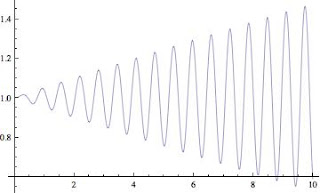
The addition of a 0.1 percent variation of the excitation makes a huge difference in the output.
A few comments are in order:
References
The system dynamics are given by
x'' + 2.0*delta*omegan*x' + (omegan^2)*x =b*omegan^2 +a*(omegan^2)*Sin[omega*t]
where x'' is the second derivative of x with respect to tim, and x' is the first.
Two runs were made. For both runs
omega = omegan = 10.0
delta = 0.001
b = 1.0
x'[0] = 0
x[0] = 1.0
For the first run a = 0.0. Thus the excitation is just a constant 1.0.
Here is a plot of the results of the first run

Note that since the excitation is the constant value 1.0, the output is the constant value 1.0
For the next run I set a = 0.001 - 0.1 percent of 1.0. Here are the results of the second run:

The addition of a 0.1 percent variation of the excitation makes a huge difference in the output.
A few comments are in order:
- This is the simplest possible example. In no way do I intend to claim that this is what's going on in global warming. The point of the example is that a resonance in a system can lead to large swings of the system variables
- Obviously for the resonance to occur, energy storage is required (the spring in our simple example) In the earth/sun system the energy storage may be in the oceans, the atmosphere, or eaven the earth itself
- Scafetta suggests that one possible source of cycling of the earth' temperature is the wobble of the sun's position caused by the gravitational pull of the Jovian planets (Jupiter, Saturn)
References
- Scafetta Talk at EPA:
http://yosemite.epa.gov/ee/epa/eed.nsf/vwpsw/360796B06E48EA0485257601005982A1#video - Various publications on Scafetta's web site:
http://www.fel.duke.edu/~scafetta/index-publications.html
Sunday, November 22, 2009
Keep fighting
Well, we didn't stop Obamacare on this vote. But that doesn't mean it's sure to become law. There are many disagreements among Democrats on what the bill should contain, and a number of Red-state Democrats are anticipating tough reelection battles. Even if Obamacare passes, there are sure to be challenges over the constitutionality of a program that requires every person to purchase health insurance. So hang in there. The battle is still raging.
Saturday, November 21, 2009
Medicare for everyone
Medicare for everyone is what Obamacare looks like to me. And that’s not good news. Several events in my life and the lives of those close to me will illustrate.
I turned 65 in September 2007 and my wife and I moved from Rochester, MI to Austin, TX in April 2008. Shortly after we moved I developed a swelling on the left side of my face. We must have called a dozen doctors trying to get an appointment. Each doctor, when he/she found out my primary insurance carrier was Medicare, wouldn’t see me. Finally we saw a physicians assistant at a clinic attached to hospital. He correctly determined that it was an allergic reaction to enalapril, a blood pressure medication I was taking. A few days later we were able to see an internist at the same clinic and he concurred with the PA’s opinion. He prescribed another blood pressure med and the problem hasn’t reoccurred. Our former physician in Rochester agreed with the diagnosis and new prescription and remarked that the reaction I had had could have been life-threatening. But doctors don’t like to take new patients who are on Medicare because of the poor reimbursements, the time required to get reimbursed, and the paperwork.
My mother has used a walker for several years, since she had a hip replacement. A few months ago I noticed a chunk missing from the tire of one of the wheels. The walker was made in China and wheels weren’t available for it. The nurse practitioner who looks after my mother told me that Medicare would pay for a new walker, but that seemed extravagant. I eventually found a wheel that fit perfectly at a local hardware store for $9.95. That’s where your tax money goes: $275 for a new walker instead of $9.95 for a wheel.
You would think that an organization like Medicare, with millions of subscribers, would use the clout of numbers to negotiate the best deal for its subscribers.
This may be true with health care practitioners, but not with vendors.
Billy Eberle’s column from GOPUSA (October 6, 2009) documents how Medicare overpays for equipment they pay for.
“We used $12075 of your benefits to recover all of your overpayment.
We have recovered all of the money you owed because of an overpayment.
In your next check we will pay you the difference between the money we have already paid you and the money you are now due.”
Huh? Perhaps they were thinking in terms of the fiction that everyone has a Social Security account with a fixed amount of money in it. In any case why was it necessary to “recover” their overpayment? They are the ones who made a mistake. They need to back out the claimed overpayment in their records, not “recover” it. We did receive a check for $368 from Social Security that month, in addition to the regular payment. Apparently it was for a cost of living increase they had withheld while my appeal was being decided. I complained to my Congressman that Social Security needed to train their letter writers to write more clearly, but I doubt that will do any good. Do you want to deal with letters like that on a regular basis? You will have to if Obamacare becomes law.
Several years ago my younger son was denied health insurance because he had a mild case of diabetes. I suspect that was due to government regulations limiting how much premiums could vary based on preexisting conditions.
The upshot of all this is that a government-run healthcare system will enormously complicate your life, with government bureaucrats looking over your shoulder as you fill out tax returns, frequently drawing the wrong conclusions, which you are then obligated to straighten out. In addition there will be no rhyme nor reason to how money is spent. Millions will be laid out to replace walkers that need only a new part, while you will be denied a medication or procedure because it costs $100.
I turned 65 in September 2007 and my wife and I moved from Rochester, MI to Austin, TX in April 2008. Shortly after we moved I developed a swelling on the left side of my face. We must have called a dozen doctors trying to get an appointment. Each doctor, when he/she found out my primary insurance carrier was Medicare, wouldn’t see me. Finally we saw a physicians assistant at a clinic attached to hospital. He correctly determined that it was an allergic reaction to enalapril, a blood pressure medication I was taking. A few days later we were able to see an internist at the same clinic and he concurred with the PA’s opinion. He prescribed another blood pressure med and the problem hasn’t reoccurred. Our former physician in Rochester agreed with the diagnosis and new prescription and remarked that the reaction I had had could have been life-threatening. But doctors don’t like to take new patients who are on Medicare because of the poor reimbursements, the time required to get reimbursed, and the paperwork.
My mother has used a walker for several years, since she had a hip replacement. A few months ago I noticed a chunk missing from the tire of one of the wheels. The walker was made in China and wheels weren’t available for it. The nurse practitioner who looks after my mother told me that Medicare would pay for a new walker, but that seemed extravagant. I eventually found a wheel that fit perfectly at a local hardware store for $9.95. That’s where your tax money goes: $275 for a new walker instead of $9.95 for a wheel.
You would think that an organization like Medicare, with millions of subscribers, would use the clout of numbers to negotiate the best deal for its subscribers.
This may be true with health care practitioners, but not with vendors.
Billy Eberle’s column from GOPUSA (October 6, 2009) documents how Medicare overpays for equipment they pay for.
- $7,215 to rent an oxygen concentrator, when the purchase price is $600.
- $4,018 for a standard wheelchair, while the private sector pays $1,048.
- $1,825 for a hospital bed, compared to an Internet price of $1,071.
- $3,335 for a respiratory pump, versus an advertised price of $1,987.
- $82 for a diabetic supply kit, instead of a $47 price on the Web
“We used $12075 of your benefits to recover all of your overpayment.
We have recovered all of the money you owed because of an overpayment.
In your next check we will pay you the difference between the money we have already paid you and the money you are now due.”
Huh? Perhaps they were thinking in terms of the fiction that everyone has a Social Security account with a fixed amount of money in it. In any case why was it necessary to “recover” their overpayment? They are the ones who made a mistake. They need to back out the claimed overpayment in their records, not “recover” it. We did receive a check for $368 from Social Security that month, in addition to the regular payment. Apparently it was for a cost of living increase they had withheld while my appeal was being decided. I complained to my Congressman that Social Security needed to train their letter writers to write more clearly, but I doubt that will do any good. Do you want to deal with letters like that on a regular basis? You will have to if Obamacare becomes law.
Several years ago my younger son was denied health insurance because he had a mild case of diabetes. I suspect that was due to government regulations limiting how much premiums could vary based on preexisting conditions.
The upshot of all this is that a government-run healthcare system will enormously complicate your life, with government bureaucrats looking over your shoulder as you fill out tax returns, frequently drawing the wrong conclusions, which you are then obligated to straighten out. In addition there will be no rhyme nor reason to how money is spent. Millions will be laid out to replace walkers that need only a new part, while you will be denied a medication or procedure because it costs $100.
Monday, October 26, 2009
We need a Constitutional Amendment
A scary event is about to take place in Copenhagen in December . Nearly 200 nations are meeting to approve a treaty to replace the Kyoto accord on climate change. The scary thing about this treaty is that, according to people who have read it, it will establish world government. If President Obama signs it and 2/3 of the Senate concur, it will become the “supreme law of the land” according to Article 6 of the United States Constitution. The President and 2/3 of the senate can supersede the Constitution.
This is obviously a dangerous provision. The framers probably put it in the Constitution to reassure nations we conduct relations with that the United States’ signature on a treaty is binding. But the power is too broad. We need a Constitutional Amendment that says something like
Any treaty signed by the President and approved by 2/3 of the Senate must be approved by ¾ of the state legislatures.
An alternative might be
Any treaty commitment signed by the President and approved by the Senate which is found to conflict with this Constitution as amended, shall be declared null and void
This is obviously a dangerous provision. The framers probably put it in the Constitution to reassure nations we conduct relations with that the United States’ signature on a treaty is binding. But the power is too broad. We need a Constitutional Amendment that says something like
Any treaty signed by the President and approved by 2/3 of the Senate must be approved by ¾ of the state legislatures.
An alternative might be
Any treaty commitment signed by the President and approved by the Senate which is found to conflict with this Constitution as amended, shall be declared null and void
Wednesday, August 19, 2009
Getting on message
Good for the Republicans. More and more I hear Republicans saying that the best way to reduce medical costs is by tort reform. Tort reform makes it more difficult to bring a frivolous lawsuit against a doctor or a hospital, and this in turn reduces the cost of malpractice insurance. Texas has implemented a review panel that reviews lawsuits against doctors and hospitals. To go forward a lawsuit must have the review board's stamp of approval. This in turn has reduced the cost of malpractice insurance, and has attracted more doctors to Texas.
Will this gain traction in Congress? It's questionable because the trial lawyers are big givers to Democrats. So keep pressing your congressman and senators.
Will this gain traction in Congress? It's questionable because the trial lawyers are big givers to Democrats. So keep pressing your congressman and senators.
Tuesday, August 18, 2009
I smell a rat
After weeks of fighting to include a “public option” in the health care bill the Obama administration suddenly backs off, saying the public option “is not the heart of the health care bill”. This may be good news, but there is still much to dislike in the health care bill:
- Funding the health care system in part by taking $500 billion from Medicare over 10 years. Many doctors already refuse to take new Medicare patients, as I found out when I moved from Michigan to Texas last year. Currently Medicare pays 80% of the amount Medicare has established for a procedure (not 80% of the price the doctor quotes). If this reimbursement goes down to 60% or lower, fewer doctors will be willing to take Medicare patients. Seniors beware if you are contemplating a move.
- Not only does the bill cover the 48 million Americans who allegedly lack health insurance, it extends to illegal aliens – upwards of 20 million people. With the bill’s stringent limits on how much doctors can be paid for their services, the number of doctors in the U. S. is likely to decline, leading to rationing of health care.
- The so-called “Insurance coops” proposed by the health care bill can serve the same purpose as the public option: Giving the government control over coverage and treatment, eventually squeezing private insurers out of the health insurance business.
- The public option is still in the House version of the bill and could be reinserted in conference.
Friday, August 7, 2009
Town Hall Meetings
With the arrival of the August Congressional recess, lawmakers are back in their districts holding town hall meetings. This year many of the meetings are experiencing large turnouts of not always polite participants. Conservatives, especially, are deeply concerned about the program President Obama is pushing:
A month remains until Congress reconvenes. That’s enough time for Congress to hire a polling organization to sample every legislative district to find out what the electorate thinks of President Obama’s healthcare proposal and what reforms they advocate in health care. Then Congress can proceed with good information about what the public supports and does not support.
- Will it increase taxes?
- What will happen to Medicare, with partial funding of the program coming from Medicare?
- Will it result in long waits for treatment and rationing of treatment?
A month remains until Congress reconvenes. That’s enough time for Congress to hire a polling organization to sample every legislative district to find out what the electorate thinks of President Obama’s healthcare proposal and what reforms they advocate in health care. Then Congress can proceed with good information about what the public supports and does not support.
Thursday, July 2, 2009
Dangerous lawmakers
Twice now in the past few months Congress has voted on bills that many members have not read. The Stimulus Bill was over a thousand pages and members were given barely 24 hours to read it. The "Cap and Trade" Bill was 1000 pages, and 300 pages were added at the last minute. Our President insists that these bills are so urgently needed that Congress must act quickly. But what happens to people who sign papers they haven't read? Answer: whatever the writer of the paper wrote would happen. If an individual signs a contract without reading it, he's stupid and deserves whatever he gets. But when a member of Congress votes yea on a bill he hasn't read, he's voting to bind the nation to whatever reckless provisions are written into the bill. This ought to be grounds for the voters who elected him to recall him, and possibly grounds for criminal prosecution.
To prevent mischief, the following ought to be added to Congress' rules for processing bills.
To prevent mischief, the following ought to be added to Congress' rules for processing bills.
- For bills longer than a specified number of pages, x days must be allowed for every y pages to give members an opportunity to read the bill
- The bill shall have a table of contents and an index
- The bill shall address only a single subject
- The bill must be readable by a sixth grader of average intelligence
- Any member caught voting on a bill he has not read will be suspended
Subscribe to:
Posts (Atom)