
With the victory of Scott Brown in Massachusetts, Republicans and conservatives are rightly celebrating. But there is a great deal of work ahead of us until November, if we expect to increase our representation in Congress. And I'm sure we can expect some dirty tricks from the Democrats between now and November. Today I viewed a PJTV Trifecta discussion that's perhaps a few days old. In it Bill Whittle finished with this quotation from John Adams:
Instead of sitting down satisfied with the efforts we have already made, which is the wish of our enemies, the necessity of the times more than ever calls for our utmost circumspection, deliberation, fortitude and perseverance. Let us remember that if we suffer tamely a lawless attack on our liberty, we encourage it and we involve others in our doom.
He finished by admonishing viewers to celebrate over the weekend and be ready to work Monday.
Good advice. Let's follow it.
The PJTV show I'm referring to can be viewed here
Friday, January 22, 2010

Sunday, January 10, 2010
An example of stochastic resonance
This post is a response to some discussion that has been going on on the American Scientific Affiliation list, which is archived here
The specific discussion this refers to is here Also see my previous post on this blog. The ASA list does not currently support uploading graphics, so I will post this part of the discussion here.
Last month I posted an example of a resonant system in which an input excitation that varied only by 0.1 % caused the system output to grow without limit, to refute the argument that solar input could not cause the warming experienced in the 20th century because TSI only varies by 0.1 %. Rich Blinne responded with
Even though resonance is theoretically possible before you go there you need to answer the question of why wasn’t there resonance for thousands of years and suddenly in the mid-20th Century things just changed?
The example I posted was a simple, second order linear system. The resonant behavior shown was constant -- it just caused the response to grow and grow forever. If the earth/sun system were a second order linear system, Rich's comment would be right on. Nonlinear systems, including the sun/earth system, are far more complicated. To illustrate I programmed the example given by Tobias and Weiss in [1].
By fiddling with the system parameters I was able to produce the plot shown below, which demonstrates one of the characteristics of nonlinear systems: the ability to show little activity for long periods of time followed by a burst of activity. (The plot is of the variable Tobias and Weiss label T.)

Not to say that this is an accurate model of interactions between the sun and climate, although Tobias and Weiss use it to illustrate sun/climate interactions — only that in nonlinear systems like the sun/climate system you can have long periods of little activity followed by a burst of activity. The sun/earth system is highly nonlinear and probably chaotic. This sort of behavior is common in chaotic systems. So the answer to Rich's comment is that the resonance was always there -- it just wasn't as active before the 20th century.
In case anyone is interested, I will be glad to make the mathematica notebook I used to generate the plot available.
Reference
[1] Tobias, S. M., Weiss, N. O. “Resonant interactions between solar activity and climate”, Journal of Climate, V 13, 1 Nov 2000, pp3745-3759
The specific discussion this refers to is here Also see my previous post on this blog. The ASA list does not currently support uploading graphics, so I will post this part of the discussion here.
Last month I posted an example of a resonant system in which an input excitation that varied only by 0.1 % caused the system output to grow without limit, to refute the argument that solar input could not cause the warming experienced in the 20th century because TSI only varies by 0.1 %. Rich Blinne responded with
Even though resonance is theoretically possible before you go there you need to answer the question of why wasn’t there resonance for thousands of years and suddenly in the mid-20th Century things just changed?
The example I posted was a simple, second order linear system. The resonant behavior shown was constant -- it just caused the response to grow and grow forever. If the earth/sun system were a second order linear system, Rich's comment would be right on. Nonlinear systems, including the sun/earth system, are far more complicated. To illustrate I programmed the example given by Tobias and Weiss in [1].
By fiddling with the system parameters I was able to produce the plot shown below, which demonstrates one of the characteristics of nonlinear systems: the ability to show little activity for long periods of time followed by a burst of activity. (The plot is of the variable Tobias and Weiss label T.)

Not to say that this is an accurate model of interactions between the sun and climate, although Tobias and Weiss use it to illustrate sun/climate interactions — only that in nonlinear systems like the sun/climate system you can have long periods of little activity followed by a burst of activity. The sun/earth system is highly nonlinear and probably chaotic. This sort of behavior is common in chaotic systems. So the answer to Rich's comment is that the resonance was always there -- it just wasn't as active before the 20th century.
In case anyone is interested, I will be glad to make the mathematica notebook I used to generate the plot available.
Reference
[1] Tobias, S. M., Weiss, N. O. “Resonant interactions between solar activity and climate”, Journal of Climate, V 13, 1 Nov 2000, pp3745-3759
Thursday, December 17, 2009
A simple example of resonance
In the climate change debate there is a faction that claims that the global warming we have experienced since approximately 1900 is due to changes in the sun's irradiance. The conventional wisdom among climate scientists is that since the solar irradiance varies only by 0.1%, solar irradiance variations are not powerful enough to bring about the observed temperature increases. However, Scafetta, West, Grigolini and others claim to have identified a stochastic resonance phenomenon that allows small variations to grow over time. Scafetta et. al.'s papers and analyses are quite challenging to follow. I am not convinced the climate change community is taking into account the resonance phenomenon. To demonstrate the potential of resonance to build up a large response from a small input I have put together a simple example using Mathematica. The example consists of a spring-mass system excited by a sinusoidal force at the resonant frequency. A small amount of damping is employed to keep the solution from growing too fast.
The system dynamics are given by
x'' + 2.0*delta*omegan*x' + (omegan^2)*x =b*omegan^2 +a*(omegan^2)*Sin[omega*t]
where x'' is the second derivative of x with respect to tim, and x' is the first.
Two runs were made. For both runs
omega = omegan = 10.0
delta = 0.001
b = 1.0
x'[0] = 0
x[0] = 1.0
For the first run a = 0.0. Thus the excitation is just a constant 1.0.
Here is a plot of the results of the first run

Note that since the excitation is the constant value 1.0, the output is the constant value 1.0
For the next run I set a = 0.001 - 0.1 percent of 1.0. Here are the results of the second run:
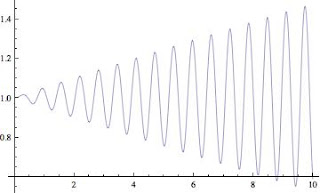
The addition of a 0.1 percent variation of the excitation makes a huge difference in the output.
A few comments are in order:
References
The system dynamics are given by
x'' + 2.0*delta*omegan*x' + (omegan^2)*x =b*omegan^2 +a*(omegan^2)*Sin[omega*t]
where x'' is the second derivative of x with respect to tim, and x' is the first.
Two runs were made. For both runs
omega = omegan = 10.0
delta = 0.001
b = 1.0
x'[0] = 0
x[0] = 1.0
For the first run a = 0.0. Thus the excitation is just a constant 1.0.
Here is a plot of the results of the first run

Note that since the excitation is the constant value 1.0, the output is the constant value 1.0
For the next run I set a = 0.001 - 0.1 percent of 1.0. Here are the results of the second run:

The addition of a 0.1 percent variation of the excitation makes a huge difference in the output.
A few comments are in order:
- This is the simplest possible example. In no way do I intend to claim that this is what's going on in global warming. The point of the example is that a resonance in a system can lead to large swings of the system variables
- Obviously for the resonance to occur, energy storage is required (the spring in our simple example) In the earth/sun system the energy storage may be in the oceans, the atmosphere, or eaven the earth itself
- Scafetta suggests that one possible source of cycling of the earth' temperature is the wobble of the sun's position caused by the gravitational pull of the Jovian planets (Jupiter, Saturn)
References
- Scafetta Talk at EPA:
http://yosemite.epa.gov/ee/epa/eed.nsf/vwpsw/360796B06E48EA0485257601005982A1#video - Various publications on Scafetta's web site:
http://www.fel.duke.edu/~scafetta/index-publications.html
Sunday, November 22, 2009
Keep fighting
Well, we didn't stop Obamacare on this vote. But that doesn't mean it's sure to become law. There are many disagreements among Democrats on what the bill should contain, and a number of Red-state Democrats are anticipating tough reelection battles. Even if Obamacare passes, there are sure to be challenges over the constitutionality of a program that requires every person to purchase health insurance. So hang in there. The battle is still raging.
Saturday, November 21, 2009
Medicare for everyone
Medicare for everyone is what Obamacare looks like to me. And that’s not good news. Several events in my life and the lives of those close to me will illustrate.
I turned 65 in September 2007 and my wife and I moved from Rochester, MI to Austin, TX in April 2008. Shortly after we moved I developed a swelling on the left side of my face. We must have called a dozen doctors trying to get an appointment. Each doctor, when he/she found out my primary insurance carrier was Medicare, wouldn’t see me. Finally we saw a physicians assistant at a clinic attached to hospital. He correctly determined that it was an allergic reaction to enalapril, a blood pressure medication I was taking. A few days later we were able to see an internist at the same clinic and he concurred with the PA’s opinion. He prescribed another blood pressure med and the problem hasn’t reoccurred. Our former physician in Rochester agreed with the diagnosis and new prescription and remarked that the reaction I had had could have been life-threatening. But doctors don’t like to take new patients who are on Medicare because of the poor reimbursements, the time required to get reimbursed, and the paperwork.
My mother has used a walker for several years, since she had a hip replacement. A few months ago I noticed a chunk missing from the tire of one of the wheels. The walker was made in China and wheels weren’t available for it. The nurse practitioner who looks after my mother told me that Medicare would pay for a new walker, but that seemed extravagant. I eventually found a wheel that fit perfectly at a local hardware store for $9.95. That’s where your tax money goes: $275 for a new walker instead of $9.95 for a wheel.
You would think that an organization like Medicare, with millions of subscribers, would use the clout of numbers to negotiate the best deal for its subscribers.
This may be true with health care practitioners, but not with vendors.
Billy Eberle’s column from GOPUSA (October 6, 2009) documents how Medicare overpays for equipment they pay for.
“We used $12075 of your benefits to recover all of your overpayment.
We have recovered all of the money you owed because of an overpayment.
In your next check we will pay you the difference between the money we have already paid you and the money you are now due.”
Huh? Perhaps they were thinking in terms of the fiction that everyone has a Social Security account with a fixed amount of money in it. In any case why was it necessary to “recover” their overpayment? They are the ones who made a mistake. They need to back out the claimed overpayment in their records, not “recover” it. We did receive a check for $368 from Social Security that month, in addition to the regular payment. Apparently it was for a cost of living increase they had withheld while my appeal was being decided. I complained to my Congressman that Social Security needed to train their letter writers to write more clearly, but I doubt that will do any good. Do you want to deal with letters like that on a regular basis? You will have to if Obamacare becomes law.
Several years ago my younger son was denied health insurance because he had a mild case of diabetes. I suspect that was due to government regulations limiting how much premiums could vary based on preexisting conditions.
The upshot of all this is that a government-run healthcare system will enormously complicate your life, with government bureaucrats looking over your shoulder as you fill out tax returns, frequently drawing the wrong conclusions, which you are then obligated to straighten out. In addition there will be no rhyme nor reason to how money is spent. Millions will be laid out to replace walkers that need only a new part, while you will be denied a medication or procedure because it costs $100.
I turned 65 in September 2007 and my wife and I moved from Rochester, MI to Austin, TX in April 2008. Shortly after we moved I developed a swelling on the left side of my face. We must have called a dozen doctors trying to get an appointment. Each doctor, when he/she found out my primary insurance carrier was Medicare, wouldn’t see me. Finally we saw a physicians assistant at a clinic attached to hospital. He correctly determined that it was an allergic reaction to enalapril, a blood pressure medication I was taking. A few days later we were able to see an internist at the same clinic and he concurred with the PA’s opinion. He prescribed another blood pressure med and the problem hasn’t reoccurred. Our former physician in Rochester agreed with the diagnosis and new prescription and remarked that the reaction I had had could have been life-threatening. But doctors don’t like to take new patients who are on Medicare because of the poor reimbursements, the time required to get reimbursed, and the paperwork.
My mother has used a walker for several years, since she had a hip replacement. A few months ago I noticed a chunk missing from the tire of one of the wheels. The walker was made in China and wheels weren’t available for it. The nurse practitioner who looks after my mother told me that Medicare would pay for a new walker, but that seemed extravagant. I eventually found a wheel that fit perfectly at a local hardware store for $9.95. That’s where your tax money goes: $275 for a new walker instead of $9.95 for a wheel.
You would think that an organization like Medicare, with millions of subscribers, would use the clout of numbers to negotiate the best deal for its subscribers.
This may be true with health care practitioners, but not with vendors.
Billy Eberle’s column from GOPUSA (October 6, 2009) documents how Medicare overpays for equipment they pay for.
- $7,215 to rent an oxygen concentrator, when the purchase price is $600.
- $4,018 for a standard wheelchair, while the private sector pays $1,048.
- $1,825 for a hospital bed, compared to an Internet price of $1,071.
- $3,335 for a respiratory pump, versus an advertised price of $1,987.
- $82 for a diabetic supply kit, instead of a $47 price on the Web
“We used $12075 of your benefits to recover all of your overpayment.
We have recovered all of the money you owed because of an overpayment.
In your next check we will pay you the difference between the money we have already paid you and the money you are now due.”
Huh? Perhaps they were thinking in terms of the fiction that everyone has a Social Security account with a fixed amount of money in it. In any case why was it necessary to “recover” their overpayment? They are the ones who made a mistake. They need to back out the claimed overpayment in their records, not “recover” it. We did receive a check for $368 from Social Security that month, in addition to the regular payment. Apparently it was for a cost of living increase they had withheld while my appeal was being decided. I complained to my Congressman that Social Security needed to train their letter writers to write more clearly, but I doubt that will do any good. Do you want to deal with letters like that on a regular basis? You will have to if Obamacare becomes law.
Several years ago my younger son was denied health insurance because he had a mild case of diabetes. I suspect that was due to government regulations limiting how much premiums could vary based on preexisting conditions.
The upshot of all this is that a government-run healthcare system will enormously complicate your life, with government bureaucrats looking over your shoulder as you fill out tax returns, frequently drawing the wrong conclusions, which you are then obligated to straighten out. In addition there will be no rhyme nor reason to how money is spent. Millions will be laid out to replace walkers that need only a new part, while you will be denied a medication or procedure because it costs $100.
Monday, October 26, 2009
We need a Constitutional Amendment
A scary event is about to take place in Copenhagen in December . Nearly 200 nations are meeting to approve a treaty to replace the Kyoto accord on climate change. The scary thing about this treaty is that, according to people who have read it, it will establish world government. If President Obama signs it and 2/3 of the Senate concur, it will become the “supreme law of the land” according to Article 6 of the United States Constitution. The President and 2/3 of the senate can supersede the Constitution.
This is obviously a dangerous provision. The framers probably put it in the Constitution to reassure nations we conduct relations with that the United States’ signature on a treaty is binding. But the power is too broad. We need a Constitutional Amendment that says something like
Any treaty signed by the President and approved by 2/3 of the Senate must be approved by ¾ of the state legislatures.
An alternative might be
Any treaty commitment signed by the President and approved by the Senate which is found to conflict with this Constitution as amended, shall be declared null and void
This is obviously a dangerous provision. The framers probably put it in the Constitution to reassure nations we conduct relations with that the United States’ signature on a treaty is binding. But the power is too broad. We need a Constitutional Amendment that says something like
Any treaty signed by the President and approved by 2/3 of the Senate must be approved by ¾ of the state legislatures.
An alternative might be
Any treaty commitment signed by the President and approved by the Senate which is found to conflict with this Constitution as amended, shall be declared null and void
Wednesday, August 19, 2009
Getting on message
Good for the Republicans. More and more I hear Republicans saying that the best way to reduce medical costs is by tort reform. Tort reform makes it more difficult to bring a frivolous lawsuit against a doctor or a hospital, and this in turn reduces the cost of malpractice insurance. Texas has implemented a review panel that reviews lawsuits against doctors and hospitals. To go forward a lawsuit must have the review board's stamp of approval. This in turn has reduced the cost of malpractice insurance, and has attracted more doctors to Texas.
Will this gain traction in Congress? It's questionable because the trial lawyers are big givers to Democrats. So keep pressing your congressman and senators.
Will this gain traction in Congress? It's questionable because the trial lawyers are big givers to Democrats. So keep pressing your congressman and senators.
Subscribe to:
Posts (Atom)